
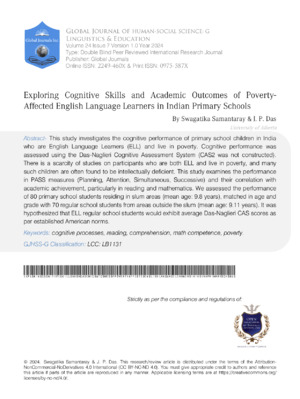
Exploring Cognitive Skills and Academic Outcomes of Poverty-Affected English Language Learners in Indian Primary Schools
Keywords:
cognitive processes, reading, comprehension, math competence, poverty
Abstract
This study investigates the cognitive performance of primary school children in India who are English Language Learners ELL and live in poverty Cognitive performance was assessed using the Das-Naglieri Cognitive Assessment System CAS2 was not constructed There is a scarcity of studies on participants who are both ELL and live in poverty and many such children are often found to be intellectually deficient This study examines the performance in PASS measures Planning Attention Simultaneous Successive and their correlation with academic achievement particularly in reading and mathematics We assessed the performance of 80 primary school students residing in slum areas mean age 9 8 years matched in age and grade with 70 regular school students from areas outside the slum mean age 9 11 years It was hypothesized that ELL regular school students would exhibit average Das-Naglieri CAS scores as per established American norms The results show that the ELL students in the slum performed somewhat lower on each of the four PASS scales but the differences were within half of 1 standard deviation based on American norm tables for CAS These findings suggest that the protective environment of the school may mitigate the effects of poverty This favorable schoolrelated climate may be attributed to Bronfenbrenner s 1979 ecological factors and protective school climate These points are further discussed in the Discussion and Conclusions section
Downloads
How to Cite
References
Published
2024-09-03
Issue
Section
License
Copyright (c) 2024 Authors and Global Journals Private Limited

This work is licensed under a Creative Commons Attribution 4.0 International License.